What should an accepted AI task cost?
OpenRouter can report the charge for a model response. It cannot tell you whether your operations manager accepted the work. Those are separate measurements, and a useful model comparison needs both. Usage accounting documentation
LLM cost per task should connect the money spent on a defined job to a result the business can use. Include failed attempts and necessary review; count a completed job once.
A lower token price can be worthwhile. It can also move work into retries, corrections and a staff queue. The decision depends on how the complete process performs against the same acceptance standard.
Here is a practical way to compare two model choices, keep the calculation honest and decide when a lower bill actually represents an improvement. The example uses invented figures, not provider prices or customer results.
What belongs in the calculation?
Start with one repeatable job: preparing an order-change request for an employee to approve, for example. Define the accepted result before looking at the model. It might require the correct account, the requested change, supporting records and a clear unresolved-questions flag.
Our recommended operating measure is the cost of all attempts, tools and required human handling for a group of requests, divided by the number of requests accepted within the agreed review window. Keep unfinished requests visible alongside that number. A cheap average with an expanding backlog is an incomplete account.
Keep two views. The first is the actual operating spend: inference, paid tools and allocated infrastructure. The second adds staff handling at an agreed loaded hourly cost. Label that second view clearly. A reduction in staff minutes creates capacity; it does not automatically reduce payroll or produce cash savings.
Suggested measurement boundary. Unfinished work stays in the cost total and is reported separately.
Set aside initial development and migration costs for the investment decision. They matter, but mixing them into a short model trial can obscure which option is cheaper to operate. For the final purchasing decision, bring those costs back and state the period over which you expect the change to repay them.
Treat privacy, permission boundaries and required accuracy as conditions of entry. An option that cannot handle the intended information under your requirements is ineligible, even if its arithmetic looks excellent. Cost comparison begins after those requirements are met.
How can the cheaper model produce the higher operating cost?
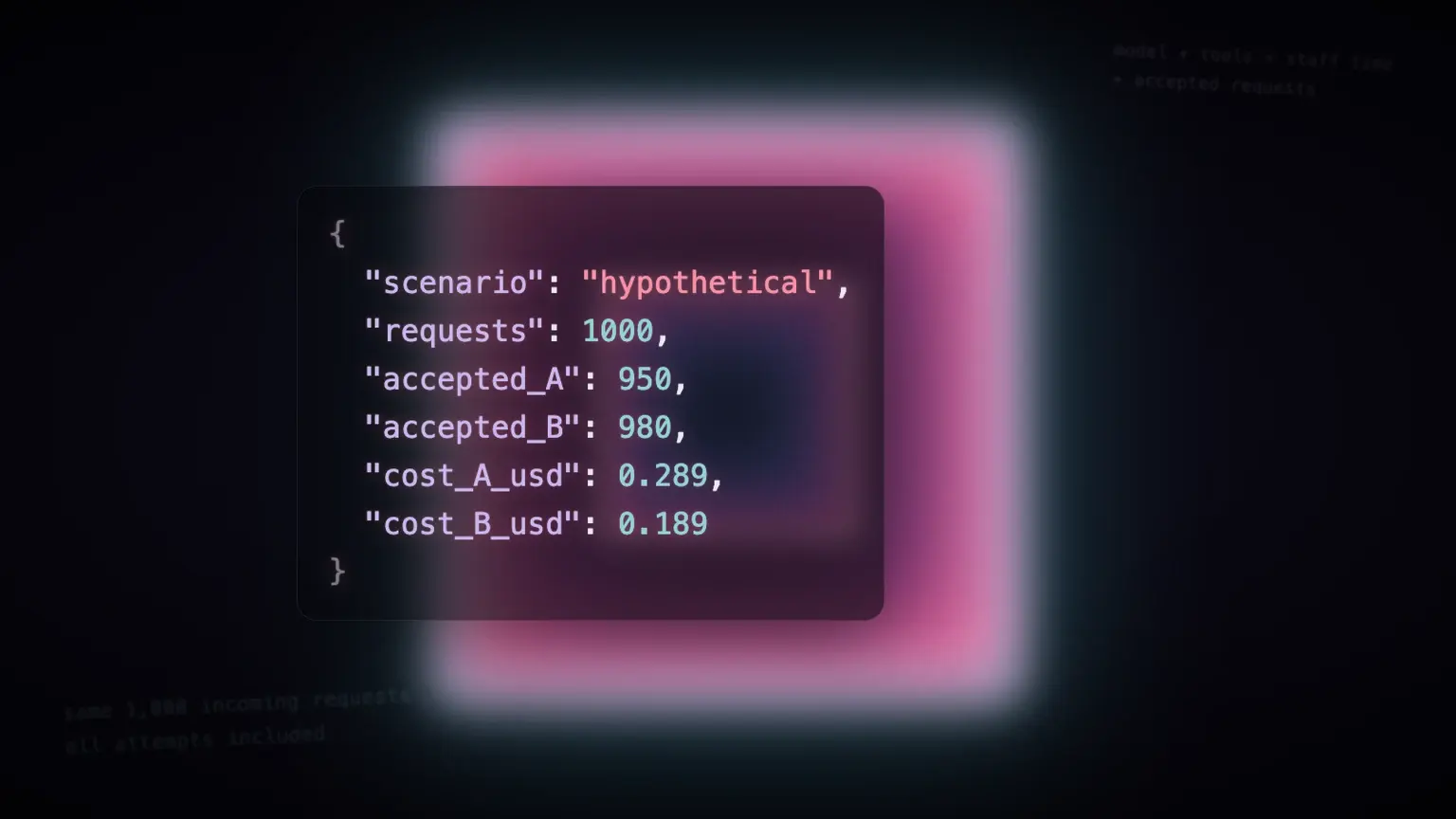
Consider this hypothetical comparison for the same 1,000 incoming order-change requests. Both options use the same review rules and completion deadline. All model charges include retries. Staff handling includes ordinary review and corrections, valued at an invented $45 an hour.
| Trial measure | Option A | Option B |
|---|---|---|
| Incoming requests | 1,000 | 1,000 |
| Model charges, including retries | $20 | $80 |
| Tools and allocated infrastructure | $30 | $30 |
| Staff handling | 300 minutes | 100 minutes |
| Value of staff time | $225 | $75 |
| Total including staff time | $275 | $185 |
| Accepted requests by the deadline | 950 | 980 |
| Cost per accepted request | $0.289 | $0.189 |
| Requests still unresolved | 50 | 20 |
Option A has the smaller model bill. In this invented trial, Option B consumes fewer staff minutes and produces more accepted results by the deadline. That makes its cost per accepted request lower under the stated assumptions. The table demonstrates a calculation; it predicts nothing about a named model.
The interpretation changes if staff handling has a different value or if both options need the same amount of review. Keep the assumptions editable. Finance should see the operating charges separately from the assigned value of time, while operations checks whether the reclaimed capacity is useful.
The cash-only view tells another part of this story. Model charges plus tools and infrastructure total $50 for Option A and $110 for Option B. That is roughly $0.053 and $0.112 per accepted request. Option B therefore spends more cash in this example while using less valued staff capacity. A finance leader can reasonably prefer either option depending on the operational constraint.
If the team has spare capacity, the additional model spend may be hard to justify. If reviews delay customer orders or keep an experienced employee away from higher-value work, the released capacity may matter more. Establish that connection instead of treating every minute saved as revenue. The decision record should explain what the team would do with the time and how the business will check whether that happens.
Also compare what went wrong. An unresolved request awaiting a missing customer document is different from a confident error that passed review. A cost average cannot make those risks equivalent. Report consequential errors separately and stop a trial that crosses the agreed safety boundary.
Which six decisions make a model comparison useful?
Here are six decisions to agree before the trial. The team should be able to explain each one without a model leaderboard.
1. Define one unit of useful work
Choose an outcome the employee receiving it can judge. “Generate a reply” is too loose if the reply invents availability or omits the customer’s question. For the order-change example, acceptance means the reviewer can make the intended decision using the prepared request and its supporting information.
Agree how to handle requests that cannot be completed. A properly identified exception may be a successful triage outcome, but it is not a completed order change. Keep those categories separate. Otherwise a system can appear more productive simply by declaring every handoff a success.
2. Compare the same mix of requests
Give each candidate the same permitted information, tools and action boundaries. Include routine cases and the ambiguous requests that consume staff time. Preserve a view of performance by category so a good average cannot hide a failing part of the business.
Keep the completion window the same for both options. Letting one candidate finish its difficult cases over several extra days gives it a different job. Report results at the agreed cutoff, then retain a later view of resolved exceptions. That separates the speed of useful work from eventual completion and makes the unresolved-work figure meaningful to the manager who owns the queue.
Use a representative workload and repeat the evaluation when results are close. Keep a separate difficult-case set for finding weaknesses; do not treat a deliberately adversarial test set as the expected daily traffic mix. Document which conclusions come from which set.
3. Attribute every attempt to its original request
OpenRouter’s accounting documentation describes input and output token counts, cost, and reasoning or cached-token details where applicable. That is useful evidence for the model portion of the bill. The business still needs to connect those charges to the original request and its final disposition.
Include retries that fail, a second model called for review and paid lookups that return nothing useful. Reconcile the trial total with the provider records. If some charges cannot be attributed, show them as unallocated rather than making them disappear from the comparison.
4. Measure the work handed to staff
Ask the people who receive the result to distinguish checking from repairing. A quick confirmation and a rewrite both count as human handling, but they suggest different improvements. Include the effort required to find the original information when the handoff is incomplete.
Review time can also move into another department. A sales team may accept a reply that later creates a support correction. Include an observation window appropriate to the task, and keep reported post-acceptance defects visible. Do not promise perfect detection from a short pilot.
5. Test the conditions that change the bill
OpenRouter’s caching guide distinguishes cache reads from writes and describes provider affinity to improve reuse. It also documents situations where routing changes. A budget based on warm-cache results alone can miss the behavior of a new session or an unavailable provider.
Compare ordinary operation with the expected exception paths. Record completion time as well as cost; a slow answer can leave a person waiting even when it is accurate. Keep the trial within approved limits, and avoid repeated retries when the request is missing information that another model cannot supply.
6. Change one decision, then check the result
Anthropic’s optimization guidance recommends measuring outcomes and spend on your own workload, comparing configurations and checking behavior before cutover. Its published comparisons are vendor measurements on specified task sets. They are starting evidence for a trial, not the result of your business process.
First compare the candidate models under a stable workflow. Then test a separate improvement, such as reducing irrelevant context or escalating only an identified class of request. Changing the model, input data and approval policy together makes it difficult to explain the outcome.
When is switching models worth it?
Switch when the evidence supports the operating change, including its exceptions. A candidate should meet the required quality, data and response-time conditions and offer a useful improvement in cost or capacity. Assign an owner to the result and preserve a way back if ordinary traffic behaves differently from the trial.
Sometimes the best finding is that model choice is not the expensive part. Missing source information, inconsistent business rules or a confusing review screen can dominate handling time. Fixing that cause may improve every eligible model. Ask what work can be eliminated before paying a different model to repeat it.
A mixed approach can be sensible when task categories differ. A specialized decision step may route a request while another system prepares the response. Each added stage must earn its cost and maintain the same permissions. Our Jev article examines that narrower decision-model role.
Provider selection and fallback restrictions are separate operating choices. Our OpenRouter routing guide covers those boundaries. This comparison should establish the cost of accepted work, without quietly changing where customer information may travel.
Bring the result to the business as a decision record: which workload was tested, what acceptance meant, the two cost views, the remaining failures and the conditions for expanding use. We expect that evidence before calling a model change an optimization.
Our agentic AI work connects model choices to the systems and employees that finish the job. If the model bill is falling while staff still repair the output, bring us the workflow you want to evaluate.
FAQs
Is cost per task the same as cost per API request?
No. A business task can involve several API requests, tools and human checks. Count their costs together, then relate the total to the agreed outcome. A response arriving successfully does not establish that the task was accepted.
Should failed attempts stay in the cost calculation?
Yes. Their costs were incurred in trying to complete the workload. Keep them in the total, count each accepted request once and show unresolved requests separately. Removing failed attempts rewards a process for hiding its own waste.
Does a higher-priced model always reduce review time?
No. Test that proposition on the same requests and acceptance rules. A more expensive model may still misunderstand the task, lack required information or produce work that employees must repair. The hypothetical comparison above is not a model recommendation.
Should we count human review as a cash saving?
Only where the financial effect is established. Reduced handling time can create useful capacity without changing payroll. Show model and tool charges separately from staff time valued at an agreed rate, and explain how the business would use that capacity.
Can a public benchmark replace our trial?
Use it to choose candidates and identify questions to test. The task mix, tools, permissions and acceptance rules may differ from yours. Keep vendor results clearly labeled and make the operating decision from evidence on your own workflow.
Written by the dplyz team
Senior engineers who work inside client companies to take AI from pilot to production: agentic workflows, AI integration and the platform work around them.