The useful job is often a small decision
Jev is worth evaluating when software needs to classify a request, judge it against a defined rubric or decide which handler should receive it. That can be a useful step in a business workflow: a message arrives, the system identifies the kind of help needed, and the appropriate process starts.
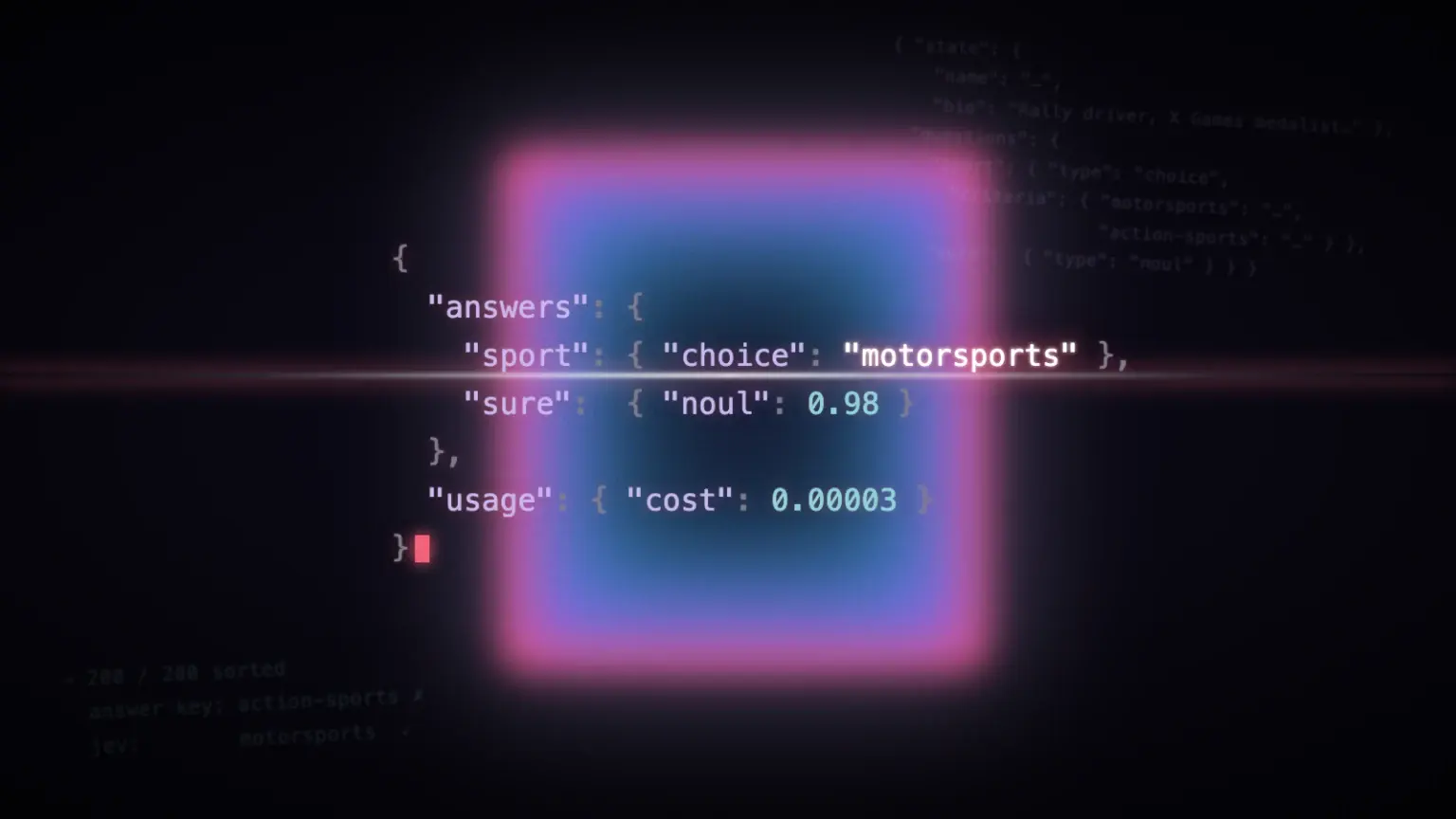
TypeSafe’s introduction describes Jev as a model for typed decisions. You supply relevant information and questions; it returns values your application can use. It does not write the customer’s reply or run the entire business process.
That division of work matters. A team handling a busy service inbox may need a judgment about the message before it needs a long answer. Evaluating a specialized decision model for that step gives the team another design option. Whether it improves speed or cost is something to measure with its own workload.
Choose the question before choosing the model
TypeSafe exposes three question types: Choice selects from defined options, Score rates against ordered criteria, and Noul evaluates a yes-or-no proposition. Choice and Score return distributions and a confidence value; Noul returns the probability of yes. The question overview explains their different purposes.
| Business question | Possible approach | What stays in ordinary code |
|---|---|---|
| Is this about a new booking, an existing booking or something else? | Choice over clearly defined categories. | Customer identity and permission checks. |
| How much specialist review does this request appear to need? | Score against a written rubric. | Assignment rules, staffing and escalation deadlines. |
| Does the message explicitly ask to cancel? | Noul, with examples of ambiguous wording. | Whether cancellation is permitted and who can authorize it. |
These are proposed designs, not measured results. If a structured field already gives you the answer, use it. There is little value in paying a model to rediscover an order status your database already knows.
Follow a request far enough to see the boundary
Imagine a hospitality group receiving: “We need to move Thursday’s dinner to next week. Can you keep the deposit?” This is a hypothetical example. A classification step might identify an existing-booking change and flag a payment-related question.
The application then looks up the authenticated customer’s booking and sends the request to the appropriate handler. Availability comes from the booking system. Deposit rules come from the applicable policy. A model’s interpretation of the message grants no authority to transfer funds or alter a reservation.
TypeSafe’s intent-routing pattern shows classifications directing work to ordinary code, another model or a person. Our design would also give mixed requests an explicit review path. Forcing the example into a single category could lose the deposit question.
Keep the original message and the routing decision available to the employee who takes over. If the model fails, times out or returns an uncertain answer, the request should remain in a visible queue with an owner. A cheaper first step has little value if it makes requests disappear.
What our benchmark showed: Jev vs. a local open-weights model
We tested this on our own data. On September 21, 2026 we ran Jev against Laya, an open-weights decision model running locally on CPU, on the same athlete profiles from our AthleteBookings research, with identical prompts. One run, 200 profiles: small enough to read every miss by hand.
| Test | Jev | Laya (local) |
|---|---|---|
| Primary sport, 20-way choice (200 athletes) | 200 of 200 | 172 of 200 |
| Spotting a wrong tag (65 planted errors) | All 65 caught, 5.6% false flags | 4 of 65 caught at the same setting; no better than chance overall |
| Athlete or personality (20 known non-athletes) | 18 of 20 | 16 of 20 |
| Median time per call | Slower, over the network | 189 ms, locally, at no cost |
Laya’s confidence was no help as a safety check. 199 of its 200 answers came back at 0.5 confidence or higher, and half of its 28 wrong answers were 99 percent sure or more. A gate that waves wrong answers through at 99 percent is not a gate.
Local was faster. Cloud was right. For a decision that routes real work, we take right.
Local models still have a real place. They keep data on your own hardware: more privacy and more data sovereignty, because nothing goes to the cloud. For a decision we could not send to Jev, a model like Laya could be the right call, but not out of the box. It would take manual training, with a person scoring answers, retraining and scoring again until the results hold. We could have spent longer training it; from what we tested, we could not trust it with this job.
Measure the whole trip, including the fallback
Run a trial beside the existing process before granting automatic actions. Use the same representative requests for each candidate approach: fixed rules where they fit, your existing model, and Jev with the proposed routing policy. Keep enough difficult cases to expose the errors that matter.
- Measure median and 95th-percentile time from receipt to a usable routing result, including lookup time, retries and any fallback. The 95th percentile shows how slow the slower end of the workload becomes.
- Record how often staff accept or correct the route. Check whether higher-confidence groups actually make fewer errors on your evaluation set.
- Track the complete workflow cost: classification, any second model, infrastructure and human review. Keep costs for failed attempts in the total.
As checked on October 12, 2026, TypeSafe lists Jev 1.13.0 at $0.042 per million input tokens, with output tokens free. Its model reference also documents text-only input, rate limits and version selection. Those are vendor terms, not our performance measurements. Recheck them before budgeting a production workload.
For scale only, a hypothetical million input tokens at that listed rate costs 4.2 cents for model input. That number excludes the rest of the workflow. A few extra minutes of staff review can matter more than the classification bill; a comparison that ignores that work can pick the wrong design.
Pin the tested model version and log the version returned. TypeSafe’s latest alias can move to a new release. Re-run the evaluation when changing the model, questions or thresholds rather than assuming the same operating behavior.
Start with a decision someone can check
A good first candidate has repeated volume, clear categories, recoverable mistakes and an employee who can explain the correct route. A poorly defined approval process will remain poorly defined after adding a fast model.
The opportunity is to let software handle more of the small judgments that hold up routine work, while keeping consequential actions bounded and reviewable. Our agentic AI work starts with that division of responsibility. Bring us a request that keeps waiting for someone to route it.
Written by the dplyz team
Senior engineers who work inside client companies to take AI from pilot to production: agentic workflows, AI integration and the platform work around them.